
Transcript
Announcer:
You’re listening to Evolve Med Ed on ReachMD. This activity is provided by Evolve Medical Education and is part of our MinuteCE curriculum.
Prior to beginning the activity, please be sure to review the faculty and commercial support disclosure statements as well as the learning objectives.
Episode 4
Dr. Subramanian:
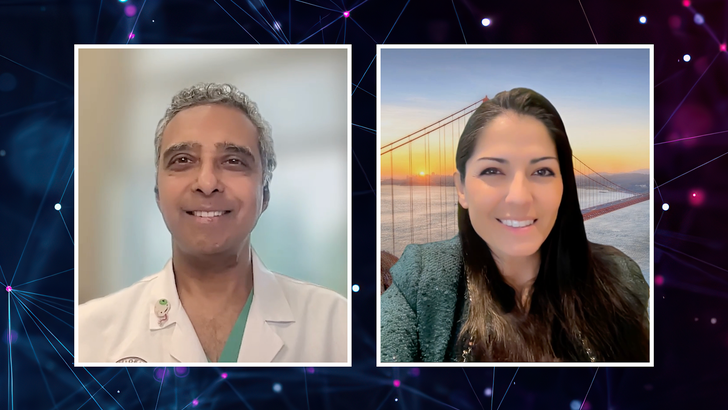
Hello, I'm Dr. Prem Subramanian, and I'm joined today by my friend Dr. Andrea Kossler, a thyroid eye disease expert, who is going to share with us today some information about treating our patients with TED. We've identified, stratified the severity of the disease, but patients often may not receive the treatment they need.
So, Andrea, what barriers are they facing when they go for treatment?
Dr. Kossler:
Such an important question, Prem. And we know that it is not easy to navigate the healthcare system in the United States, but our thyroid eye disease patients have a unique burden. We know that thyroid eye disease impacts women more frequently than men, oftentimes in the fourth to sixth decade of life, when work and family demands are at their peak.
A treatment course can last up to 6 months, and there can be multiple treatments needed afterwards. So this can result in requiring disability leave, leave from work, family support, and it can have financial sacrifice.
And we also know that patients have access limitations, even here in the United States. There are insurance companies that will deny medications for our treatments, and there are healthcare systems that don't even have these drugs on formulary.
For patients that can get medications, targeted medications for their disease, then they have to deal with our healthcare system. And so that oftentimes requires driving to an infusion center, parking and paying for both of those things, sitting through 8 infusions or more for 60 to 90 minutes, finding that infusion center, finding expertise, and then having to coordinate the ophthalmology and the endocrinology and the primary care visits, as well as labs and hearing tests. And there’s just so much for our patients to navigate; it can really be a full-time job for our patients to care for themselves.
And so there's a lot of things that we can do to help our patients and to really meet them where they're at. I actually have a full-time nurse and a PA that helps me with my thyroid eye disease patients.
And so first of all, we need to understand their socioeconomic situation, their health literacy, if they have any language barriers, and we have to connect them to resources to help them to get that ride to the infusion center, to help them figure out their insurance or their financial situation, and to make sure that they're fully understanding the impact that this disease and treatment options can have not only on their family, but on their health, and on the support network around them.
And then, when we're thinking about treatment, I do think that there's things that we can do to lessen the treatment burden. And so if we can treat them with a drug that is similarly effective but requires less infusions, less infusions over less amount of time, shorter infusion durations, or if we can have a home health nurse go to their house and give them an IV infusion, or better yet, an oral medication or a subcutaneous injection.
So the more that we can meet our patients where they're at and limit that treatment burden, I think we can really decrease that access to treatment that many of our patients are facing.
Now, we currently have multiple treatments out there, and this is just a slide showing the infusion schedules. We see that teprotumumab requires 8 infusions over 24 weeks for about 60 to 90 minutes each. Veligrotug is about 30 minutes. It's 5 infusions, about 15 weeks. IV methylprednisolone every week for 12 weeks for about 3 months. Rituximab is a slow infusion. We usually give about 2 over 2 weeks. And then we have tocilizumab, about 1 hour once a month for about 4 months.
Now, there is also a lot of drugs in the pipeline. You can see this slide here with these different options. What's exciting is that we have subcutaneous and oral drugs that are potentially going to be on the horizon, and I really think this will be a really big game changer for our patients.
We also have IL-6 antagonists in development, which are also subcutaneous, and you can see the different dosing formulations here.
Now, all of these are currently being studied, but I think the more options that we have to meet our patients in their home, where they're at, for shorter time periods with similar efficacy, the better we'll be able to treat our patients and lower the treatment burden.
Dr. Subramanian:
Andrea, that's a great approach. And thank you for that overview of things that are in the pipeline. I'm excited about them as well.
I have a nurse navigator I introduce my patients to when they first see me for thyroid eye disease, so they meet her and know that she's there to help her. And taking this team approach to our patients, I think, is the best way to help them to get the treatments they need.
I want to thank our listeners for being here to learn about thyroid eye disease, and stay tuned for more to come.
Announcer:
You’re listening to Evolve Med Ed on ReachMD. This activity is provided by Evolve Medical Education and is part of our MinuteCE curriculum.
To receive your free CE credit, or to download this activity, go to https://evolvemeded.com/cme/. Thank you for listening.
 In support of improving patient care, Global Learning Collaborative (GLC) is jointly accredited by the Accreditation Council for Continuing Medical Education (ACCME), the Accreditation Council for Pharmacy Education (ACPE), and the American Nurses Credentialing Center (ANCC) to provide continuing education for the healthcare team.
  Global Learning Collaborative (GLC) has been authorized by the American Academy of Physician Associates (AAPA) to award AAPA Category 1 CME credit for activities planned in accordance with AAPA CME Criteria. This activity is designated for 1.0 AAPA Category 1 CME credit(s). Approval is valid until July 15, 2027. PAs should claim only the credit commensurate with the extent of their participation in the activity.
 Global Learning Collaborative (GLC) designates this activity for a maximum of 1.0 contact hour(s)/0.10 CEUs of pharmacy continuing education credit.